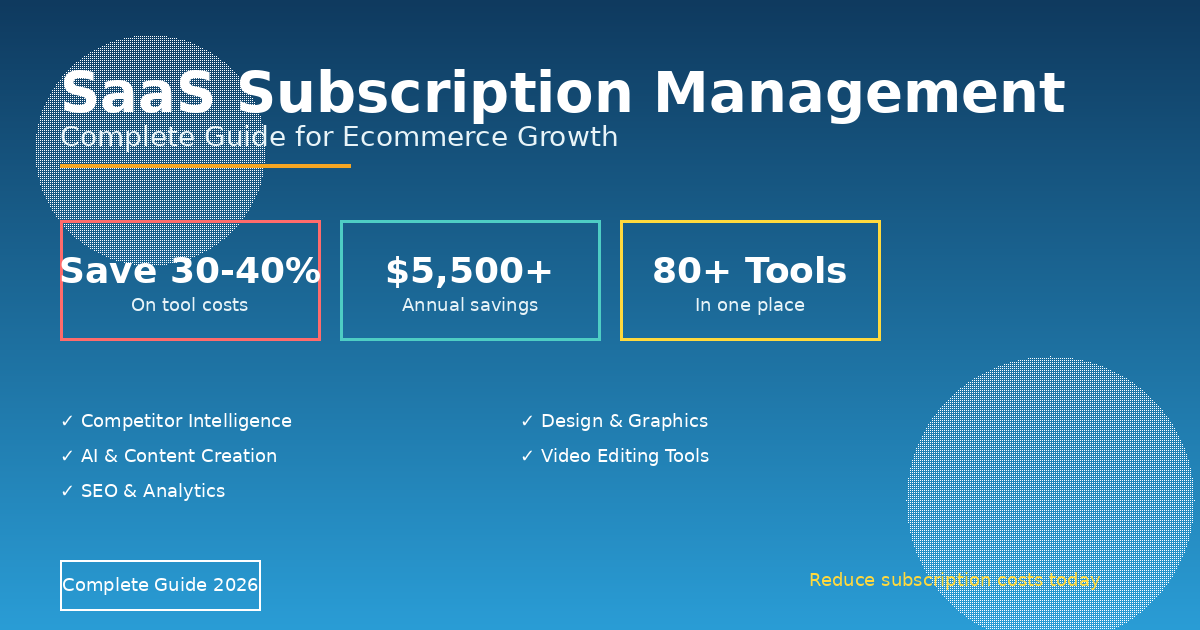
Running an ecommerce business today requires juggling multiple software tools simultaneously. From product research and competitor analysis to content creation and SEO optimization, each tool serves a critical function. However, this necessity comes with a significant cost burden. This guide explores the real expenses of maintaining a complete ecommerce toolkit, practical strategies for subscription management, and how successful entrepreneurs are addressing these challenges without compromising on functionality.
Understanding the True Cost of Modern Ecommerce Tools
The ecommerce landscape has transformed dramatically over the past five years. What once could be managed with a single platform now requires integration across dozens of specialized applications. Each addresses a specific need, and for good reason—specialized tools often outperform generalist solutions in their particular domain.
However, this specialization creates what many entrepreneurs call “subscription fatigue.” When you calculate the cumulative monthly costs of essential tools, the numbers can become sobering.
Breaking Down the Typical Ecommerce Toolkit
| Tool Category | Common Tools | Typical Monthly Cost |
|---|---|---|
| Competitor Intelligence | Product research, market analysis | $100 – $250/mo |
| AI & Copywriting | Content creation, automation | $80 – $180/mo |
| Visual Content | Design, image generation, editing | $60 – $150/mo |
| SEO & Analytics | Keyword research, competitor tracking | $100 – $250/mo |
| Video Production | Editing, voiceover, animation | $50 – $150/mo |
| Design & Assets | Templates, stock images, fonts | $30 – $100/mo |
$420-$1,080
Average monthly subscription costs for a small-to-medium ecommerce operation with essential tools
This represents $5,040 to $12,960 annually—a substantial expense for businesses operating on typical ecommerce margins. For many entrepreneurs, especially those just starting out, this cost structure raises a critical question: How do you maintain competitive advantage without breaking your budget?
The Impact of Subscription Costs on Business Profitability
The relationship between tool expenses and profitability isn’t straightforward. More expensive doesn’t always mean better, and the right tools for one business may be wasteful for another. Understanding your actual usage patterns and ROI on each tool becomes essential.
Questions Every Entrepreneur Should Ask
- Which tools directly contribute to revenue generation versus operational efficiency?
- Are you using all available features, or paying for capabilities you don’t need?
- Could multiple functions be consolidated into fewer, better-integrated solutions?
- What’s the actual onboarding time, and does it justify the monthly cost?
- How does each tool’s learning curve affect your team’s productivity?
Many entrepreneurs discover that they’re maintaining subscriptions more out of habit than necessity. Tools purchased for specific projects continue to drain resources long after their usefulness ends. Additionally, redundancy is common—multiple tools often overlap in functionality, creating waste.
Key Insight: The goal isn’t having the most tools; it’s having the right combination of tools that integrate well, solve your specific problems, and deliver measurable value. A toolkit with 10 well-integrated tools consistently outperforms 50 disconnected, poorly-implemented solutions.
Proven Strategies for Optimizing Your Tool Stack
1. Conduct a Comprehensive Subscription Audit
Start by documenting every subscription your business currently maintains. Go through bank statements, credit card bills, and accounting records. For each tool, track:
- Monthly/annual cost
- Primary use case and expected benefit
- Actual usage frequency over the last 30 days
- Whether the tool is essential, valuable, or redundant
- Integration with your existing systems
This exercise often reveals that 30-40% of subscriptions provide minimal ROI and can be eliminated immediately. This alone might reduce costs by $150-$400 monthly without functional impact.
2. Evaluate Consolidation Opportunities
Rather than using six different tools for content creation, visual design, copywriting, and publishing, consider integrated platforms that combine multiple functions. While these may have trade-offs in specialization, the efficiency gains and cost reduction can be substantial.
Consolidation benefits extend beyond cost:
- Reduced learning curve with fewer interfaces
- Better data flow between integrated functions
- Simplified team onboarding and training
- More reliable customer support relationships
3. Explore Bundled Solutions
The market has responded to subscription fatigue by creating bundled offerings that combine multiple complementary tools. These bundles work best when they align with your actual workflow and tool preferences. Consider:
- What tools are you actually using daily?
- Would a bundle include tools you don’t need, or would it fill gaps effectively?
- What’s the total cost comparison with your current stack?
- Is there flexibility to upgrade or customize over time?
Before Switching to a Bundle
- Test the tools included with a free trial whenever possible
- Verify integration compatibility with your existing workflow
- Check support quality and response times
- Understand the terms—can you cancel monthly or are you locked into annual commitment?
- Review user feedback on specific tools you’ll be using most
Building a Sustainable Tool Strategy
Tier Your Tools by Importance
Not all tools deserve equal investment. Create a three-tier system:
Tier 1 (Critical): Tools that directly impact revenue—competitor research, market analysis, fulfillment automation. Invest appropriately here; these tools pay for themselves.
Tier 2 (Valuable): Tools that improve efficiency—content creation, design, analytics. Optimize spending but maintain quality.
Tier 3 (Nice-to-Have): Supplementary tools for specific projects. Use sparingly or consider trial periods.
Implement Usage Monitoring
Most SaaS tools provide usage analytics. Review these quarterly to identify underutilized subscriptions. If a tool is costing $50/month but you use it once every three months, it’s a candidate for elimination or replacement.
Negotiate and Leverage Annual Billing
Many vendors offer 20-30% discounts for annual commitments. If a tool proves valuable after 3-6 months, switch to annual billing. Even with an upfront cost, the savings are typically substantial.
Additionally, contact vendor sales teams. Enterprise-level discounts sometimes extend to smaller businesses willing to commit to longer terms or multiple product purchases.
20-40%
Average savings achieved by ecommerce entrepreneurs after implementing systematic subscription management
The Role of Bundled Platforms in Modern Ecommerce
Bundled solutions aren’t a one-size-fits-all answer, but they serve a legitimate purpose in the ecommerce ecosystem. For entrepreneurs building businesses on limited budgets, or those prioritizing simplicity over specialization, bundled offerings provide genuine value.
The key is understanding what you’re optimizing for: maximum feature depth and specialization, or cost efficiency and simplicity? Your answer should drive your tooling decisions.
When Bundles Make Sense
- Early-stage businesses with limited budgets
- Solopreneurs managing multiple business functions alone
- Businesses prioritizing cash flow over premium features
- Teams seeking faster onboarding and training
When Specialized Tools Remain Superior
- Established businesses with clear competitive advantages in specific areas
- Operations requiring deep feature sets in particular domains
- Teams with specialized roles and tool preferences
- Businesses where integration APIs and automation are critical
The answer for most successful ecommerce operators is a hybrid approach: using specialized, best-in-class tools for critical functions while consolidating or bundling elsewhere.
Future Considerations and Emerging Trends
The SaaS market continues evolving rapidly. Several trends are worth monitoring:
AI-Powered Consolidation
Artificial intelligence is enabling more comprehensive bundled solutions by automating integration between previously disparate tools. This trend is likely to continue, offering entrepreneurs more consolidated options without sacrificing functionality.
Usage-Based Pricing
Instead of flat monthly fees, more vendors are adopting usage-based or tiered pricing. This aligns costs more directly with value delivered, potentially benefiting moderate-usage customers.
Open Ecosystem Plays
Rather than trying to build everything internally, leading vendors are creating open ecosystems where users can mix and match best-of-breed tools. This provides flexibility while reducing lock-in risk.
These developments suggest that the future likely holds more choice and flexibility rather than forced consolidation or artificial specialization.
Take Action Today
Start with the first step: conduct your subscription audit. Identify your top 10 expenses and evaluate their actual ROI. You may discover immediate opportunities to reduce costs while maintaining or improving functionality.
Final Thoughts
The cost of running an ecommerce business has never been higher due to the proliferation of specialized tools. However, this complexity also creates opportunity—entrepreneurs willing to strategically evaluate and optimize their tool stack can achieve substantial cost reductions while maintaining or improving operational efficiency.
The businesses winning in ecommerce today aren’t necessarily those with the most expensive tools or the largest tool count. They’re the ones who have thoughtfully considered their specific needs, tested solutions thoroughly, and maintained discipline about what truly delivers value.
Whether you ultimately choose specialized tools, bundled solutions, or a hybrid approach, the key is making an intentional decision based on your specific business needs rather than defaulting to industry standards or vendor marketing claims.
About This Article: This guide is based on analysis of ecommerce industry standards, publicly available pricing information, and general business practices. Specific tool recommendations and pricing should be verified directly with vendors as rates change regularly. Every business is unique—evaluate tools based on your specific requirements rather than industry averages.
⚠️ Disclosure: This article contains affiliate links. We earn a commission if you purchase through our links, at no extra cost to you.
We recommend checking out our guide on cost-effective tools here (affiliate link).
Affiliate Disclosure: Some links in this article are affiliate links, which means we may earn a commission if you make a purchase.