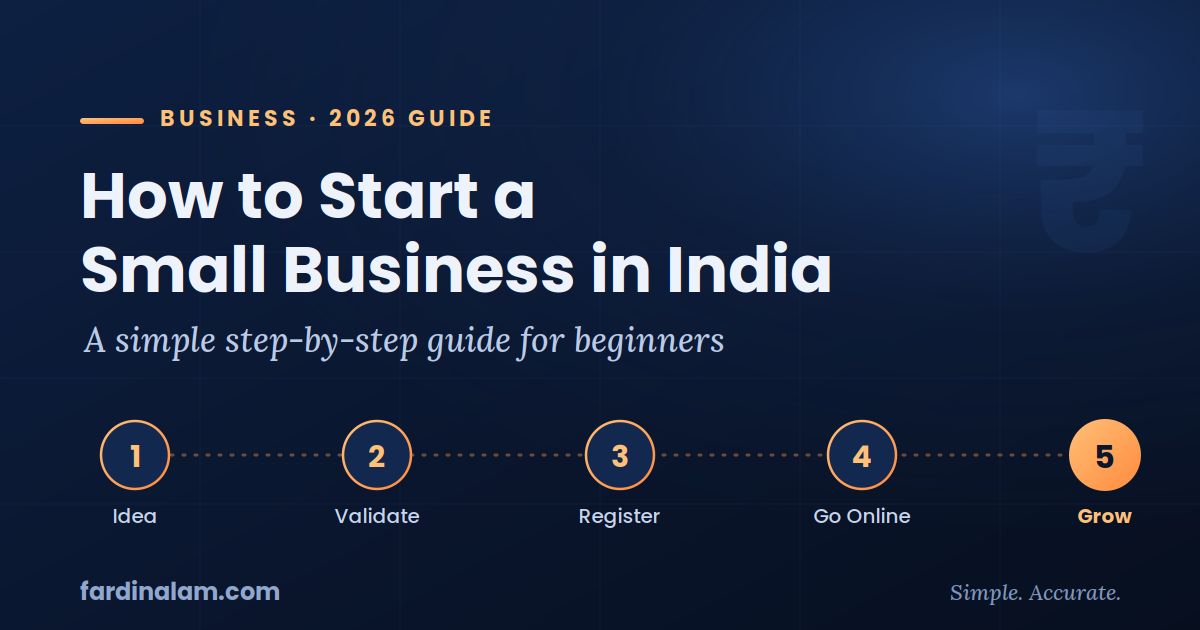
Starting a business used to mean renting a shop, buying inventory, and risking your savings before you knew if the idea even worked. In 2026, that is no longer true. Digital payments are instant, customers happily buy from new brands online, and you can register a business from your phone in a few minutes. The barrier to starting has never been lower.
But “easy to start” is not the same as “easy to succeed.” Most small businesses do not fail because the idea was bad — they fail because the founder skipped the basics or gave up too soon. This guide walks you through the actual steps to start a small business in India this year, in plain language, without the hype. Follow them in order and you will avoid the mistakes that trip up most beginners.
Step 1: Choose the Right Business Idea
The best business idea is not the trendiest one — it is the one that matches your skills, your budget, and a real demand. Ask yourself three questions before picking anything.
First, what can you actually do well? A business built on a skill you already have (cooking, design, teaching, repairs, content creation) starts faster and costs less than one you have to learn from scratch. Second, will people pay for it? An idea is only a business if customers are willing to spend money on it regularly. Third, how much can you invest without stress? Be honest about the money you can afford to lose, because early income is rarely steady.
Some low-investment ideas that work well in India right now include home-based food businesses, tuition and coaching, freelance services like writing or video editing, social media management for local shops, handmade products, and reselling. The point is not to chase the “perfect” idea but to pick one that fits your situation and start.
Step 2: Validate the Idea Before Spending Big
This is the step almost everyone skips, and it is the most important. Before you invest serious money, test whether people will actually buy.
Validation can be simple. Talk to ten people who fit your target customer and ask what they currently use and what frustrates them. Offer your product or service to a few customers at a small scale — a few orders, a couple of clients, a single batch. If people pay you once, that is real proof. If they keep coming back, that is a business.
The goal here is to learn cheaply. It is far better to discover a problem with your idea after spending ₹2,000 than after spending ₹2,00,000. Treat your first month as an experiment, not a launch.
Step 3: Plan Your Money Carefully
You do not need a fancy business plan, but you do need clarity on three numbers.
Your startup cost is everything you need to spend before earning your first rupee — materials, basic tools, packaging, a logo, or a small marketing budget. Keep this as lean as possible at the start. Your price is what you charge, and it must cover your costs and leave a profit. Many beginners price too low out of fear; remember that a price too low to make a profit is not a business, it is a hobby. Your break-even point is how many sales you need to cover your costs. Knowing this number keeps you grounded.
One practical habit makes a big difference: keep your business money separate from your personal money from day one. Open a separate account or at least a separate UPI handle for the business. This single step makes tracking, taxes, and decisions far easier later.
Step 4: Register Your Business
You can start small as a sole proprietor without heavy paperwork, which is why most first-time founders begin that way. But getting your business formally recognised brings real benefits, and in India the key registration for small businesses is Udyam (MSME) registration.
Udyam registration is the government’s official recognition system for Micro, Small, and Medium Enterprises. The good news for beginners: the process is completely online, free of cost, and based on your Aadhaar and PAN — there is no government fee and no document uploads required. You apply on the official portal at udyamregistration.gov.in, verify your Aadhaar with an OTP, validate your PAN, fill in basic business details, and receive a digital certificate with a unique Udyam Registration Number. This system replaced the older Udyog Aadhaar process a few years ago, so Udyam is now the valid route.
A registered MSME can access priority lending, certain government schemes, and protection on delayed payments — useful as you grow. Registration is not legally mandatory just to operate, but it is worth doing once you are serious.
A few other things to know. You only need GST registration if your turnover crosses the threshold set by law or if your type of business specifically requires it; many small businesses below the limit can operate without it at first. Depending on what you sell, you may also need a specific licence — for example, a food business needs an FSSAI registration. Because rules and limits can change, always confirm the current requirements on the official government portals before you rely on them.
Step 5: Set Up a Simple Online Presence
In 2026, your online presence often matters more than a physical address. You do not need an expensive website on day one, but you do need to be findable.
Start with the basics. Create a Google Business Profile if you serve a local area — it puts you on Google Maps and search for free. Set up a WhatsApp Business account for orders and customer chats, since most Indian customers prefer it. Pick one social platform where your customers actually spend time (Instagram for visual products, for instance) and post consistently rather than spreading yourself thin across five apps.
A clean, honest presence beats a flashy fake one. Real photos of your product, clear pricing, and quick replies build more trust than stock images and big promises.
Step 6: Get Your First Customers
A business with no customers is just an expensive hobby, so this step deserves real effort. Your first customers usually come from the people and places closest to you.
Begin with your own network — friends, family, and local groups — not as a favour, but because they are the easiest people to reach. Ask satisfied customers for referrals and reviews, because word of mouth is still the most powerful marketing in India. Join local WhatsApp and community groups where your customers gather. If you have a small budget, a modest, well-targeted ad can help, but do not spend on ads before you have proven that people want what you sell.
Focus on making your first ten customers genuinely happy. Their reviews and referrals will bring the next hundred far more cheaply than any advertisement.
Step 7: Keep Records and Stay Consistent
Once orders start coming in, simple discipline keeps the business healthy. Track your income and expenses, even in a basic notebook or free spreadsheet, so you always know whether you are actually making a profit. Set aside a little money for taxes and reinvestment instead of spending everything you earn. Review what is working every month and do more of it.
Above all, give the business time. Most successful small businesses look unremarkable in their first few months. The founders who win are usually not the most talented — they are the ones who kept showing up after the excitement wore off. Commit to staying consistent for at least 90 days before judging whether an idea works.
Common Mistakes to Avoid
A few predictable mistakes cause most early failures, and you can sidestep all of them.
Spending too much before validating is the biggest one — never invest your savings into inventory or equipment before customers have proven they will buy. Pricing too low is another; underpricing to attract customers often just attracts people who will not stay and leaves you with no profit. Trying to do everything at once spreads you thin, so focus on one product and one channel until they work. Mixing personal and business money creates confusion that compounds over time. And quitting too early wastes all the effort you have already put in, usually right before things would have started to click.
Final Thoughts
Starting a small business in India in 2026 is genuinely achievable, and the tools available today make it easier than at any point in the past. But the fundamentals have not changed: pick an idea that fits you, test it cheaply, handle your money with care, register and stay compliant, find customers, and keep going long enough to give it a fair chance.
You do not need perfect conditions or a large investment to begin — you need clarity and one concrete first step. Choose your idea today, talk to a few potential customers this week, and let momentum build from there. The hardest part is starting, and you are already past the part where most people only dream about it.
This article is for general informational purposes only and does not constitute legal, financial, or tax advice. Business registration rules, tax thresholds, and licensing requirements can change — always verify current requirements on official government portals or consult a qualified professional before making decisions.
