“Should I put my savings in an FD or start a SIP?” It’s one of the most common money questions in India — and the honest answer is that it depends less on which product is “better” and more on when you’ll need the money. Here is a clear FD vs SIP comparison for 2026, with real numbers and simple tax rules.
This guide explains both in simple terms, compares them with real numbers, and helps you decide what fits your goal.
What is an FD?
A Fixed Deposit (FD) is money you lock with a bank for a fixed period at a fixed interest rate. You know exactly how much you’ll get on maturity.
For reference, in October 2026, SBI’s FD rates for regular customers run from about 3% for very short tenures to around 6.4% on standard tenures, with special schemes going a little higher. Senior citizens get roughly 0.5% extra. (Rates change often — always check your bank’s latest rate sheet.)
Bank FDs are also protected by DICGC deposit insurance up to ₹5 lakh per depositor, per bank.
What is a SIP?
A SIP (Systematic Investment Plan) is a way to invest a fixed amount every month in a mutual fund — for example ₹2,000 on the 5th of every month. When you invest in an equity mutual fund through a SIP, you buy units at different market prices over time, which averages out your cost.
Unlike an FD, SIP returns are not guaranteed. In good years, equity funds can grow strongly; in bad years, your investment can fall below what you put in. Over longer periods (7 years or more), equity has historically delivered higher returns than FDs, but past performance is no guarantee of the future. That difference is the heart of the FD vs SIP debate.
FD vs SIP: side-by-side comparison
| Factor | Fixed Deposit (FD) | SIP in an equity mutual fund |
|---|---|---|
| Returns | Fixed and known in advance | Market-linked, not guaranteed |
| Risk | Very low | Moderate to high in the short term |
| Best for | Goals within 1–3 years, emergency fund | Goals 5+ years away |
| Safety net | DICGC cover up to ₹5 lakh per bank | No guarantee; regulated by SEBI |
| Liquidity | Can break early, usually with a small penalty | Can redeem anytime (some funds charge exit load within 1 year) |
| Taxation | Interest added to your income and taxed at your slab rate | Equity gains taxed only when you sell, at special rates |
| Minimum amount | Often ₹1,000 | As low as ₹100–₹500 per month |
FD vs SIP with real numbers: ₹5,000 a month
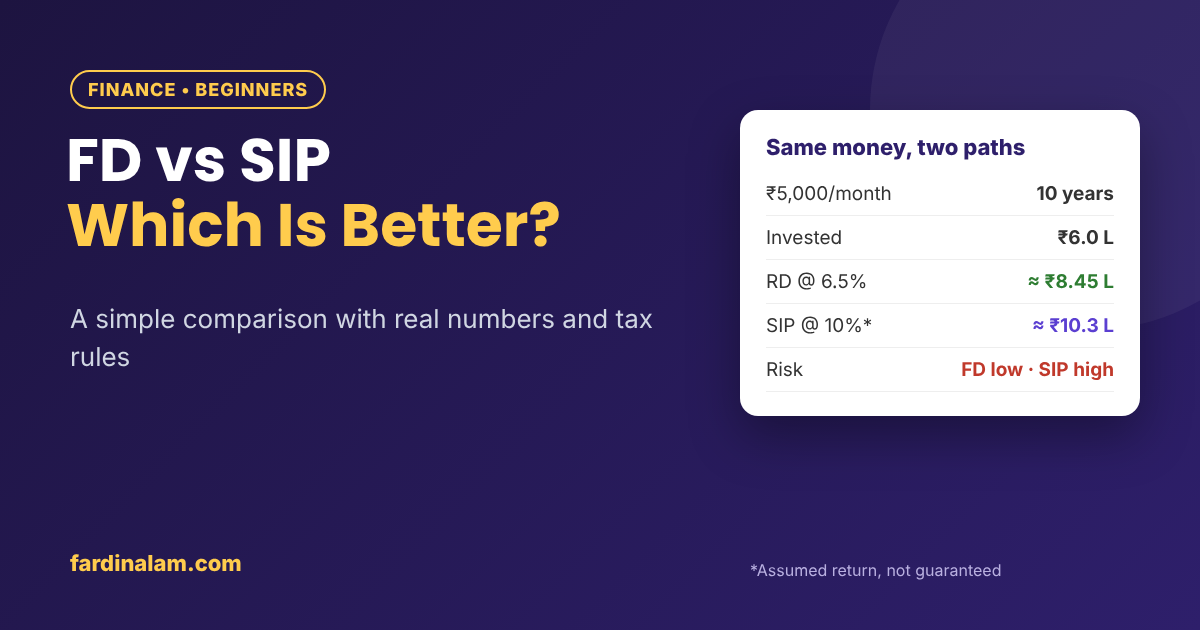
Suppose you invest ₹5,000 every month. Below, the FD side uses a recurring deposit at 6.5% a year. The SIP side shows assumed average annual returns of 8%, 10% and 12% — these are illustrations, not predictions.
| Period | You invest | Recurring deposit @ 6.5% | SIP @ 8% | SIP @ 10% | SIP @ 12% |
|---|---|---|---|---|---|
| 5 years | ₹3,00,000 | ≈ ₹3.55 lakh | ≈ ₹3.70 lakh | ≈ ₹3.90 lakh | ≈ ₹4.12 lakh |
| 10 years | ₹6,00,000 | ≈ ₹8.45 lakh | ≈ ₹9.21 lakh | ≈ ₹10.33 lakh | ≈ ₹11.62 lakh |
(Before tax. SIP figures assume a steady return every year, which never happens in real markets.)
Two things stand out:
- Over 5 years, the gap is fairly small — and a bad market year near the end could wipe it out.
- Over 10 years, the gap grows meaningfully, because compounding has more time to work.
That’s exactly why the time horizon decides the answer.
FD vs SIP: how tax changes the picture
- FD interest is added to your income every year and taxed at your slab rate, even if you don’t withdraw it. Banks deduct TDS if your interest from one bank crosses ₹50,000 in a year (₹1 lakh for senior citizens). If you’re in the 30% slab, a 6.5% FD earns you closer to 4.5% after tax.
- Equity mutual fund gains are taxed only when you sell. Gains on units held for more than a year are long-term: the first ₹1.25 lakh of long-term gains in a financial year is tax-free, and the rest is taxed at 12.5%. Units sold within a year are taxed at 20%.
For people in higher tax slabs, this difference can matter as much as the return itself.
So which should you choose?
Choose an FD if…
- You’ll need the money within 1 to 3 years — a wedding, a course fee, a bike, a house down payment.
- It’s your emergency fund (3–6 months of expenses). Safety and quick access matter more than returns here.
- You can’t sleep if your investment drops 15% in a bad month.
Choose a SIP if…
- Your goal is 5 years or more away — retirement, a child’s education, long-term wealth.
- You can keep investing every month without stopping when markets fall.
- You already have an emergency fund in place.
The smart answer: use both
Most people don’t need to pick one. A simple, sensible structure: So in the FD vs SIP choice, time matters more than the product.
- First, build an emergency fund in an FD or savings account.
- Then, put money for short-term goals in FDs/RDs.
- Finally, start a SIP for long-term goals — even ₹1,000 a month is a good start — and increase it as your income grows.
Common mistakes to avoid
- Stopping a SIP when markets fall. Falling markets are when SIPs buy more units cheaply. Stopping locks in the bad part and misses the recovery.
- Putting emergency money in equity. Emergencies often come when markets are also down.
- Chasing last year’s top fund. Choose diversified, low-cost funds with a long track record instead.
- Ignoring tax on FDs. Compare post-tax returns, not headline rates.
- Breaking FDs often. Penalties and lost interest add up. Split large amounts into a few smaller FDs instead.
Before you invest, however, check the facts yourself. For example, AMFI’s investor corner explains how mutual funds and SIPs work, and your bank’s website lists its current FD rates. Also, past returns never guarantee future returns, so read the scheme documents carefully.
If you are just starting, then first read our guide on how to build an emergency fund in India. Besides that, a strong credit history helps later, so see how to check and improve your CIBIL score.
FD vs SIP: frequently asked questions
Is a SIP better than an FD?
For long-term goals (5+ years), SIPs in equity funds have historically offered higher returns. For short-term goals and emergency money, FDs are better because they’re safe and predictable.
Can I lose money in a SIP?
Yes, especially over short periods. Equity investments can fall in value. The risk generally reduces the longer you stay invested, but it never becomes zero.
What’s the minimum amount to start a SIP?
Many mutual funds allow SIPs from ₹100 to ₹500 a month. Remember this whenever someone asks you about FD vs SIP.
Are FDs completely safe?
Bank FDs are very safe and are insured by DICGC up to ₹5 lakh per depositor per bank. Corporate FDs offer higher rates but carry more risk and no DICGC cover.
Should I break my FD to start a SIP?
Usually not. Let the FD mature, and start the SIP from your monthly income. Keep your emergency fund untouched.
The bottom line on FD vs SIP
An FD protects your money; a SIP grows it over time. If you need the money soon, choose safety. If your goal is years away, give your money the chance to grow. And for most people, the right answer is a mix of both.
Disclaimer: This article is for general education only and is not investment advice. Mutual fund investments are subject to market risks; read all scheme-related documents carefully. Interest rates and tax rules may change — check the latest information or consult a SEBI-registered investment adviser before investing.