Every festive sale, the same two words sit under almost every phone, laptop and TV on Amazon and Flipkart: No Cost EMI. Pay in six instalments, pay nothing extra. It sounds like free money. Before you tap that button, here is how no-cost EMI really works and what it costs you.
It isn’t free. But it isn’t a scam either. It’s a pricing trick that is sometimes a good deal and sometimes quietly costs you more than paying upfront. The only way to know which is to do the math — so let’s do it properly, with real numbers, before you hit “Buy Now” this Diwali.
The short answer: No-cost EMI on a credit card usually costs you a few hundred rupees in GST and processing fees, and it often makes you lose the instant bank discount or cashback you would have got by paying in full. Use it only when you genuinely need to spread the payment and you are certain you will pay every instalment on time.
How “No Cost EMI” actually works
Banks don’t lend money for free. When you convert a purchase into EMIs, the bank charges interest — typically somewhere around 13% to 16% a year on credit card EMIs. So where does the “no cost” come from?
The seller or brand pays it for you. Here’s the mechanism:
- The product is listed at, say, ₹30,000.
- When you choose no-cost EMI, the seller gives an upfront discount equal to the interest the bank will charge over the tenure.
- The bank lends you the discounted amount and charges interest on it.
- Your instalments (principal + interest) add up to exactly ₹30,000 — the original price.
So the interest is real. You do pay it. It just gets cancelled out by a discount you never see as a separate line — which is why the total looks like “zero extra”.
The hidden costs of no-cost EMI
If the interest is cancelled out, where’s the catch? There are three of them.
1. GST on the interest
On credit card EMIs, the interest you pay is a financial service, and 18% GST is charged on the interest portion. The seller’s discount covers the interest — not the GST on it. That part comes out of your pocket and shows up on your card statement over the next few months. That is the first hidden cost of no-cost EMI.
2. Processing fee (plus GST on it)
Most banks charge a one-time EMI processing fee — commonly ₹199 to ₹299 on credit cards, and some charge a percentage of the amount. Add 18% GST on that fee too.
3. The discount you give up
This is the one that hurts the most and gets noticed the least. During big sales, the best deal is often an instant bank discount for full payment (10% off up to a limit) or a cashback card like the Amazon Pay ICICI card. Many of these offers are lower — or not available at all — when you choose no-cost EMI. Cashback cards usually don’t give cashback on EMI conversions either.
Let’s do the real math: a ₹30,000 phone
Assumptions (typical, but check your own bank’s terms): credit card EMI at 15% a year, 6-month tenure, ₹199 processing fee.
| Item | Amount |
|---|---|
| Listed price | ₹30,000 |
| Seller’s no-cost discount (= the bank’s interest) | ₹1,270 |
| Amount the bank actually lends you | ₹28,730 |
| Your monthly EMI × 6 | ₹5,000 × 6 = ₹30,000 |
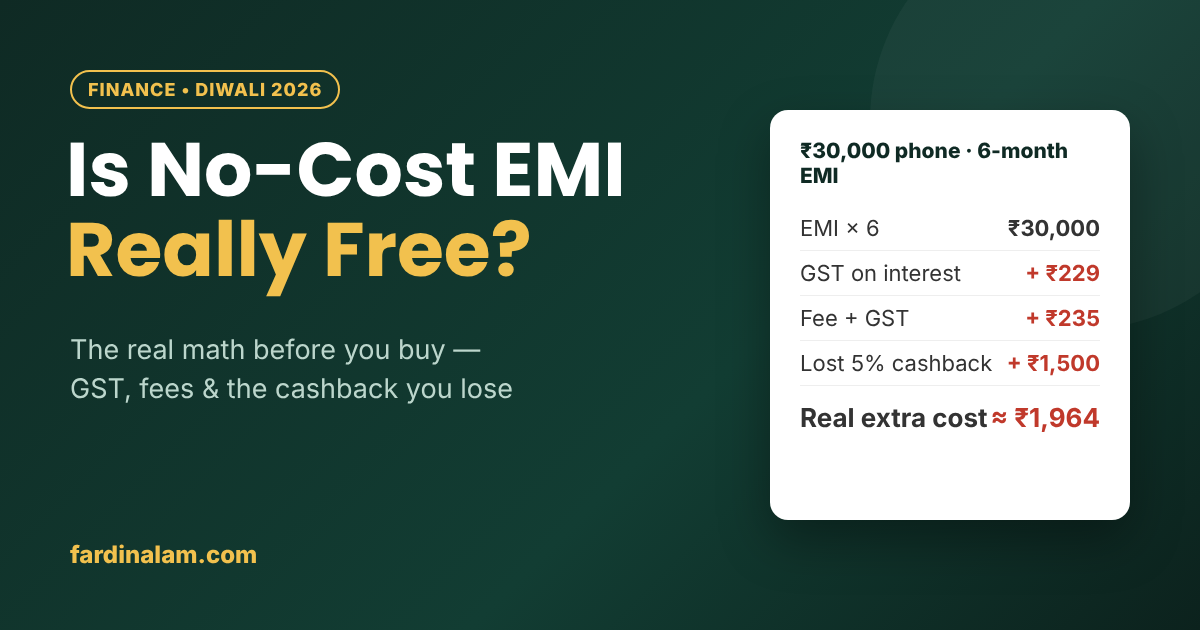
| GST @ 18% on the ₹1,270 interest | ≈ ₹229 |
| Processing fee ₹199 + 18% GST | ≈ ₹235 |
| Total extra you actually pay | ≈ ₹464 |
So the “no cost” EMI costs about ₹464 on a ₹30,000 phone. That’s about 1.5% — not terrible, and in many cases it’s a fair price for the convenience.
Now compare it with paying in full on a card that gives 5% back:
| Option | What you really pay for the ₹30,000 phone |
|---|---|
| No-cost EMI (6 months) | ≈ ₹30,464 |
| Full payment with 5% cashback card | ₹30,000 − ₹1,500 = ≈ ₹28,500 |
| Full payment with 10% instant bank discount (if eligible) | ₹27,000 or less |
That’s a difference of roughly ₹2,000 to ₹3,500 on a single purchase. If paying upfront doesn’t strain your budget, it is almost always the cheaper choice.
When no-cost EMI is actually a smart move
It’s not always a bad idea. It makes sense when:
- You need the item now but your cash flow is tight — for example, a laptop you need for work, and paying ₹60,000 at once would wipe out your emergency fund.
- The same bank discount applies on EMI too. Some sales give the instant discount on EMI transactions as well. Then the only extra cost is GST and the fee.
- There’s no processing fee and the tenure is short (3–6 months).
- You have no cashback card, so you aren’t losing any rewards by choosing EMI.
- You’re 100% sure you’ll pay on time. More on this below.
When to avoid no-cost EMI
- When you’re buying something you can’t afford — a ₹1 lakh phone on a ₹30,000 salary. A small monthly number makes an expensive decision feel cheap. That’s the real danger of EMI, not the GST.
- When you already have two or three EMIs running. Each one looks small; together they quietly eat a big chunk of your monthly income.
- When you might return or cancel the product. Cancelling an EMI midway can bring foreclosure charges, GST on those charges and interest for the running month. Read the cancellation terms before you buy.
- When the tenure is long (12–24 months) with a fee. Longer tenure means more interest, which means more GST on it.
The hidden credit-limit and credit-score effect
When you convert ₹30,000 into EMIs, your bank usually blocks the full ₹30,000 from your credit limit and releases it bit by bit as you pay each instalment. If your card limit is ₹50,000, you’ve suddenly got only ₹20,000 left for the next few months. So the real price of no-cost EMI is often a little higher than the sticker price.
High credit utilisation can pull your credit score down for a while. And if you miss even one EMI, you’ll face late fees, interest on the overdue amount and a negative mark on your credit report — which costs far more than anything you saved.
A simple 5-step checklist before you click “No Cost EMI”
- Check the “Pay in full” price with the best bank offer. Note the final amount.
- Open the EMI breakdown on the payment page. Look for the interest amount, processing fee and the bank’s GST note.
- Add up: GST (18% of interest) + fee + GST on fee + any cashback you’ll lose.
- Compare the two totals. If the difference is small and you need the cash flow, EMI is fine. If it’s ₹2,000+, think twice.
- Set up auto-pay for at least the total amount due on your card, so you never miss an instalment.
Before you choose an EMI offer, however, read the fine print yourself. For example, the Reserve Bank of India has cautioned banks since 2013 that “zero per cent interest” schemes often recover the interest through fees. Also, ask the seller for the full repayment schedule before you pay.
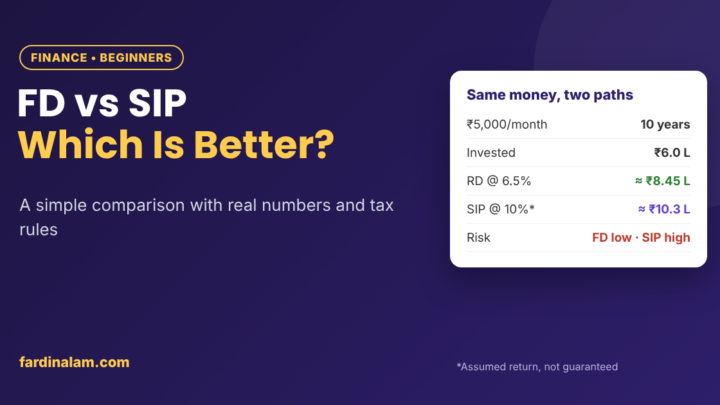
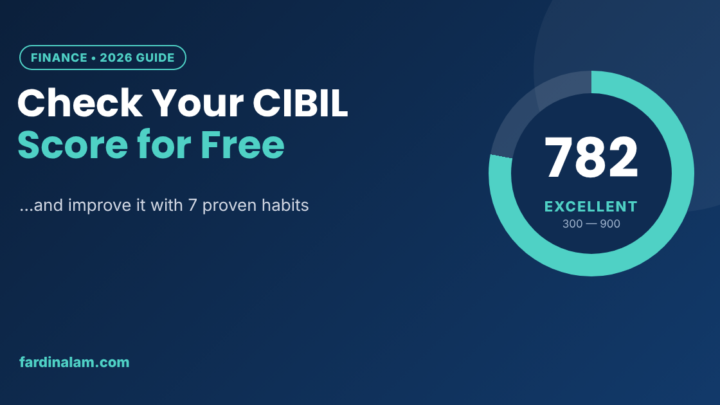
If you want to protect your credit profile, then read how to check and improve your CIBIL score. Besides that, our FD vs SIP guide shows a simple way to save for big purchases instead.
No-cost EMI: frequently asked questions
Is no-cost EMI really interest-free?
No. The bank still charges interest; the seller simply gives you an equal discount so the total matches the listed price. You still pay GST on that interest on credit card EMIs.
Can I get no-cost EMI on a debit card?
Some banks offer debit card EMI to pre-approved customers. The terms differ from credit card EMIs, so check the fee and the bank’s offer page before you choose it.
Does no-cost EMI affect my credit score?
Indirectly, yes. It blocks part of your credit limit (raising utilisation), and any missed payment is reported to credit bureaus. Paying every EMI on time has no negative effect and can help build your history. Used this way, no-cost EMI can still be a good deal.
What happens if I return the product?
Usually the EMI is cancelled and the loan is closed, but you may still be charged the processing fee, interest for the running cycle, foreclosure fees and GST. Each bank’s terms are different — read them before buying.
Is “Buy Now Pay Later” the same as no-cost EMI?
Not exactly. BNPL services have their own fees (processing, convenience or late fees). Treat them with the same caution and compare the final amount you’ll pay.
The bottom line on no-cost EMI
No-cost EMI is a tool, not a gift. On a ₹30,000 purchase it typically costs you around ₹400–₹500 extra — and up to ₹3,000 more if it makes you miss a full-payment bank discount or cashback. If you have the money, pay in full with the best card offer. If you need to spread the payment, choose a short tenure with no processing fee, keep your utilisation in check and never miss an instalment.
Happy Diwali shopping — and buy what you need, not what the EMI makes look affordable.
Disclaimer: This article is for general education only and is not financial advice. Interest rates, fees and offers differ by bank, card and seller, and change often. The example above uses assumed figures — always check the exact EMI breakdown and terms on your bank’s and the seller’s pages before buying.

1 Comment